


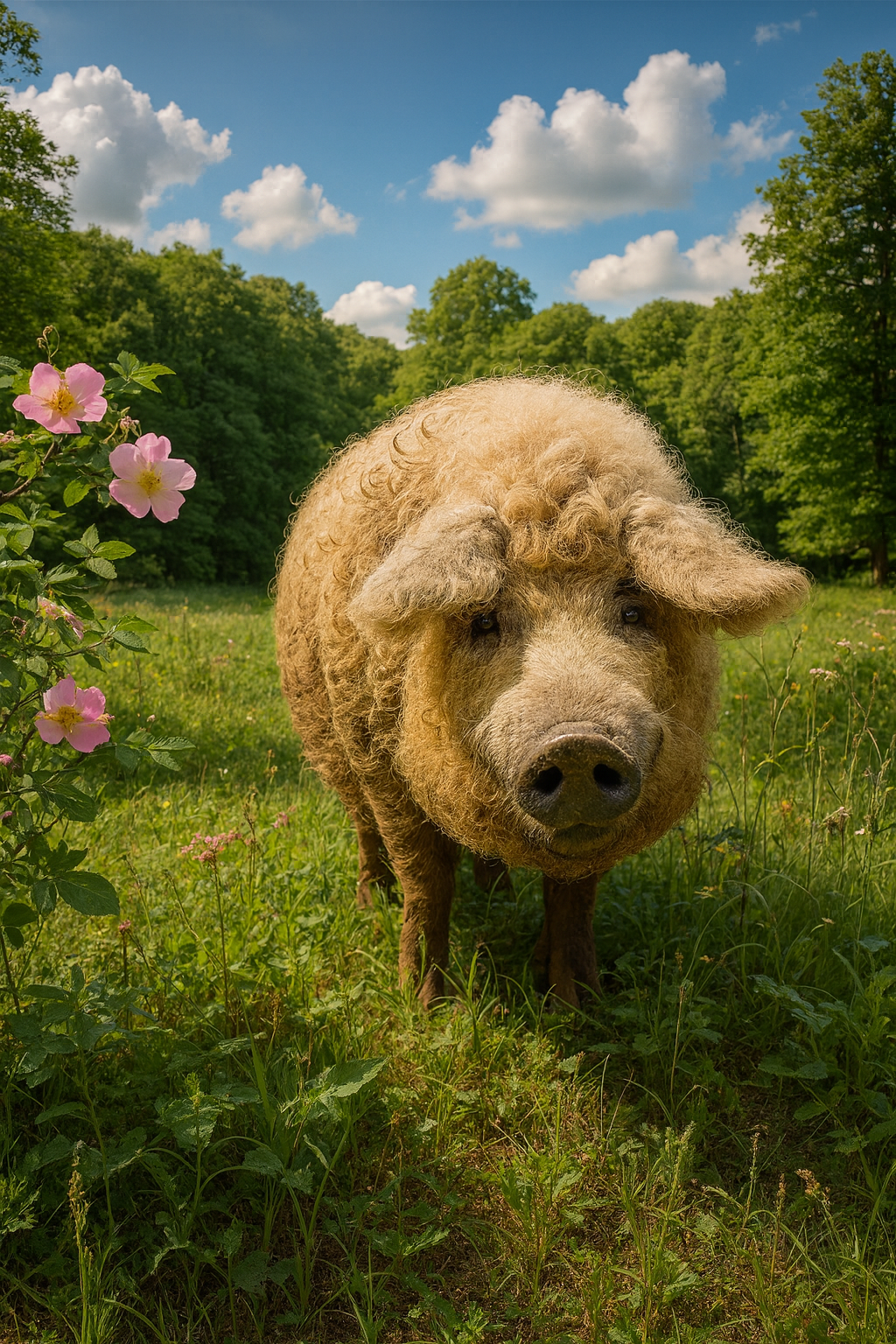
The History of the Mangalica – From Ancient Pastures to a Symbol of Hungarian Tradition
Although the history of the Mangalica spans just about 150 years, its importance to Hungary’s culture and economy is immense. This breed of pig, with its curly coat and marbled meat, dominated livestock farming for decades and today is once again regarded as a national treasure – a true hungarikum. Its story is one of rise and fall, near extinction, and eventual revival.
The Earliest Traces and the Etymology of the Name
The word mangalica first appeared in records in 1791, when it was noted that a shepherd from Ajka had a herd of pigs stolen, described as “partly mangaritz, partly Hungarian.” A few years later, in 1795, the Grassalkovich estate purchased 110 pigs referred to as “mangolicza.”
The name has Slavic origins – just like the word szalonna (bacon). This is no coincidence. From the early 19th century, Serbian Šumadija pigs were imported to Hungary. Crossed with the native Bakonyi and Szalontai pigs, they gave rise to a new breed.
Native Breeds Before the Mangalica
Before the Mangalica took over, Hungary was home to many semi-wild pig varieties:
-
Bakonyi – dark, curly-haired, resilient to harsh conditions, likely brought into the Carpathian Basin with the Magyars.
-
Szalontai – large, reddish-brown, long-legged, with drooping ears, raised mostly in the east.
-
Siska – common in the south, gradually displaced by the Mangalica.
-
Other local breeds, such as nádi (marsh), réti (meadow), báznai from Transylvania, and lengyel (Polish) in the northeast, also disappeared in the 19th century.
As zoologist Alfred Brehm observed, each of these breeds was “a child of the soil,” shaped by climate and available forage. Over time, however, they were all replaced by the more uniform and easier-to-raise Mangalica.
Trade and the Importance of Fattening
By the 18th century, live pig trade already played a vital role in Hungary’s economy. Herds were driven to markets in Sopron and Győr, and from there on to Vienna.
During these long treks, pigs fed on oak acorns in the forests of Bakony and Somogy. Thanks to its strong build, the Mangalica thrived on such journeys and quickly proved ideal for fattening.
A true breakthrough came when potatoes and maize began to be widely cultivated in the south. These crops allowed for efficient feeding and opened the way for intensive stationary fattening.
The Birth of the Mangalica – Planned Breeding
The new breed emerged from crossing Serbian Šumadija pigs with Bakonyi and Szalontai pigs. A decisive moment came in 1833, when Archduke Joseph of Habsburg imported a herd from the estate of Prince Miloš Obrenović in Belgrade.
Ten sows and two boars were placed at his estate in Kisjenő (Arad). They formed the foundation of systematic breeding, which expanded in the estates of Mezőhegyes and Bábolna. By the mid-19th century, the population had become uniform enough to be recognized as a distinct Hungarian national breed – the Mangalica.
The Golden Age of the 19th Century
The Mangalica rose rapidly in popularity. Its meat and lard were prized not only in the Austro-Hungarian Empire but throughout Europe.
By the late 19th century, herds numbered in the millions. In 1884, over 4.8 million pigs were raised in Hungary; by 1895, 6.4 million; and by 1911, 6.47 million.
Large-scale fattening enterprises emerged, such as the first Hungarian pig-fattening company in Kőbánya, where up to 600,000 animals passed through annually. Industrial fattening yielded fast results: a 14-month-old Mangalica could reach 200 kg, with record-breaking individuals exceeding 500 kg.
Challenges and Threats
Progress, however, came at a price. Epidemics, especially swine fever imported from America, decimated populations – between 1895 and 1915 alone, 4.5 million pigs, mostly Mangalicas, perished.
At the same time, consumer preferences began to shift toward leaner meat, paving the way for English and German breeds. Hungarian authorities encouraged their import, further weakening the Mangalica’s dominance.
The 20th Century – From Dominance to Decline
At the start of the 20th century, the Mangalica still reigned supreme – in the 1930s, it made up 82% of Hungary’s pig stock.
After World War II, the situation changed dramatically. Wartime losses and the introduction of modern breeding technologies pushed the Mangalica to the margins. By the 1960s and 70s, its numbers had collapsed – in 1976, only 43 breeding sows were registered in the entire country.
It seemed the breed was doomed to vanish forever.
Protection and Revival
In 1973, the Hungarian authorities declared the Mangalica a protected breed. Conservation programs began, creating small genetic reserve herds.
True revival, however, came only after 1990. In 1994, the Mangalica Breeders’ Association was re-established, spearheading the restoration of the breed.
At first, only 750 sows remained in the country, but thanks to determined breeders and rising demand for premium products, numbers grew rapidly. Within just over a decade, the population increased fiftyfold.
The Mangalica Today – Three Varieties and Global Fame
Currently, three main varieties are bred:
-
The Blonde Mangalica (szőke mangalica)
-
The Red Mangalica (vörös mangalica)
-
The Swallow-bellied Mangalica (fecskehasú mangalica)
Each has unique traits, yet all produce exceptionally juicy, marbled meat. Mangalica products, especially hams and sausages, are exported widely – particularly to Spain, where they are compared to jamón ibérico.
A Symbol of Culture and Tradition
In 2004, the Mangalica was officially recognized as a hungarikum, a national treasure of Hungary. The decision highlighted that preserving native breeds is part of national identity.
Today, the Mangalica stands as an ambassador of Hungarian cuisine worldwide. Its meat graces the tables of top restaurants, and festivals dedicated to the breed attract thousands of visitors – from Budapest to Madrid.
The story of the Mangalica proves that tradition and modernity can go hand in hand. Thanks to the passion of breeders and state support, a once-forgotten breed has been rescued and is once again shaping the prestige of Hungarian agriculture.


![616x948_Eros_Pista_2600g_616x948px_202210_gasztro[1].png](/environment/cache/images/productGfx_570_500_500/616x948_Eros_Pista_2600g_616x948px_202210_gasztro1.webp "616x948_Eros_Pista_2600g_616x948px_202210_gasztro[1].png")


