


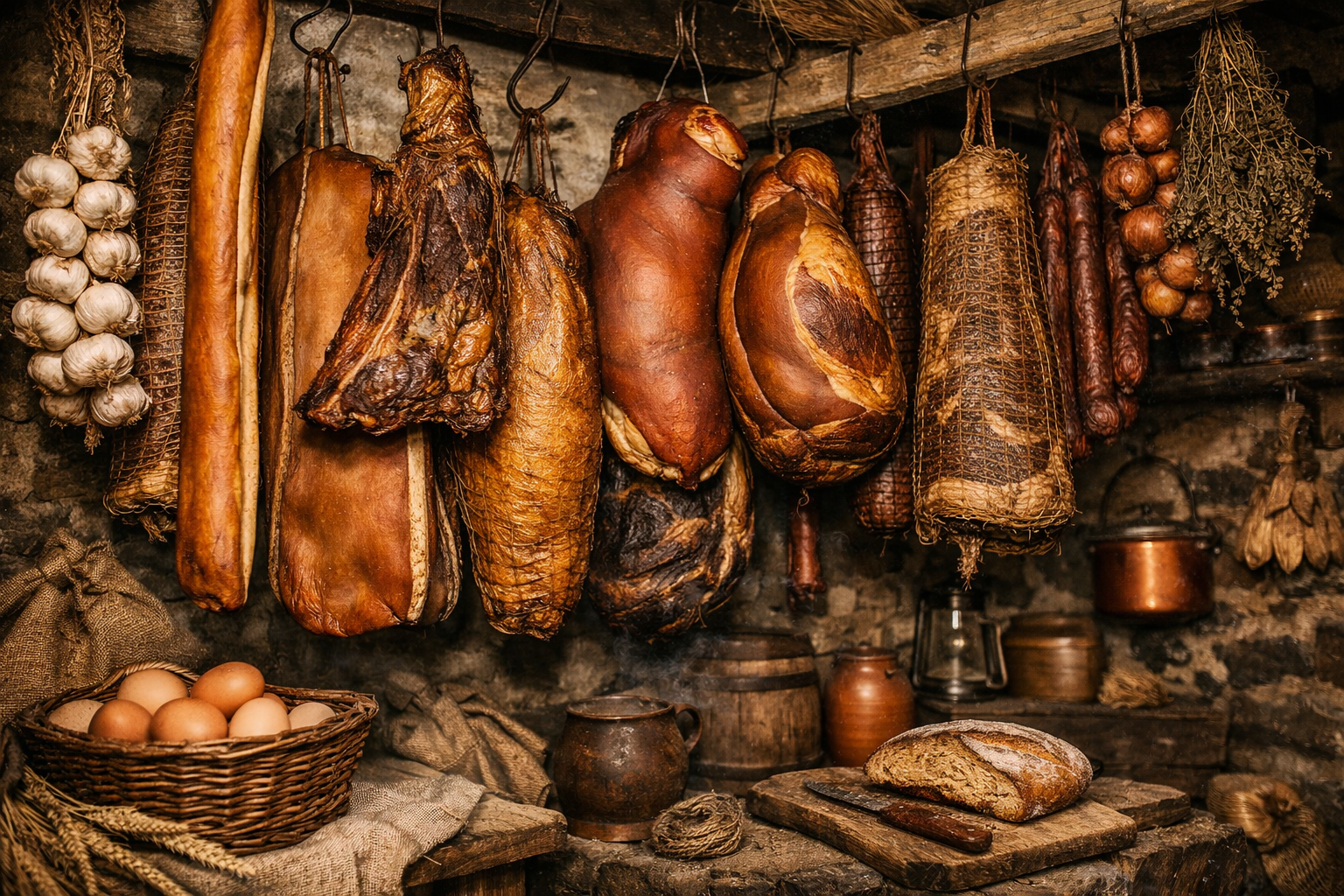
Traditional Smoking Methods in Hungary – A Flavor Rooted in History
In Hungary, smoking was for centuries not only a way to improve the taste of meat, but also one of the most important methods of preserving it. Once pig slaughter was finished and the hams, ribs, bacon, sausages, liver sausages, and head cheese were ready, the next question was how to keep them from spoiling. Today, in a world of refrigerators and freezers, storing meat is relatively simple. In earlier times, however, preserving food depended on household knowledge, experience, and traditional techniques passed down through generations.
One of the simplest methods was to roast the meat first and then pour melted fat over it. The layer of fat sealed the product from the air, allowing it to keep for months. Sausages could be preserved in a similar way. Although this method is rarely seen today, it was once practical, natural, and highly effective. It also produced exceptionally flavorful food, even if it was hardly the kind of thing one would associate with dieting.
The History of Smoking in Hungary
The history of smoking reaches so far back that it is impossible to identify a single inventor. Archaeological research confirms that, alongside drying and salting, smoking is one of the oldest methods of food preservation known to humankind. As soon as people learned to use fire, they also discovered that smoke could help preserve meat and fish.
In Hungary, the tradition of smoking was especially strong. For generations, almost every rural household had a smokehouse or a so-called open chimney used for naturally smoking homemade products. Smoking was part of daily life and an essential element of rural food culture. Historical descriptions show that the process was carefully understood and deliberately controlled. Meat was first left to dry and air out for several days, and only then was it exposed to smoke—at first mild, then gradually stronger.
Even centuries ago, people knew that heavy smoke alone was not enough. Meat became more flavorful when a bit of fresh air reached it along with the smoke. If it was exposed to overly strong smoke from the very beginning, it could develop an unpleasant odor. This shows that traditional Hungarian smoking methods relied not just on habit, but on careful judgment and a refined understanding of the process.
Why Was Meat Smoked? The Main Purposes of Smoking
Smoking has always served three essential purposes. The first was preservation. Heat and smoke reduced the moisture content of the meat, making it harder for bacteria to multiply and allowing the product to keep much longer.
The second purpose was flavor. Smoke gave meat its distinct aroma and deep, rich taste—the very qualities that made traditional Hungarian hams, sausages, and bacon so prized. Smoking made these foods more appetizing, more intense, and more satisfying.
The third purpose was to preserve food without sacrificing its quality. When done properly, smoking not only slowed spoilage but also allowed the meat to retain its nutritional value. That is why smoking remained one of the most important methods of meat preservation in Hungarian rural households for so many centuries.
What Was Traditionally Smoked in Hungary?
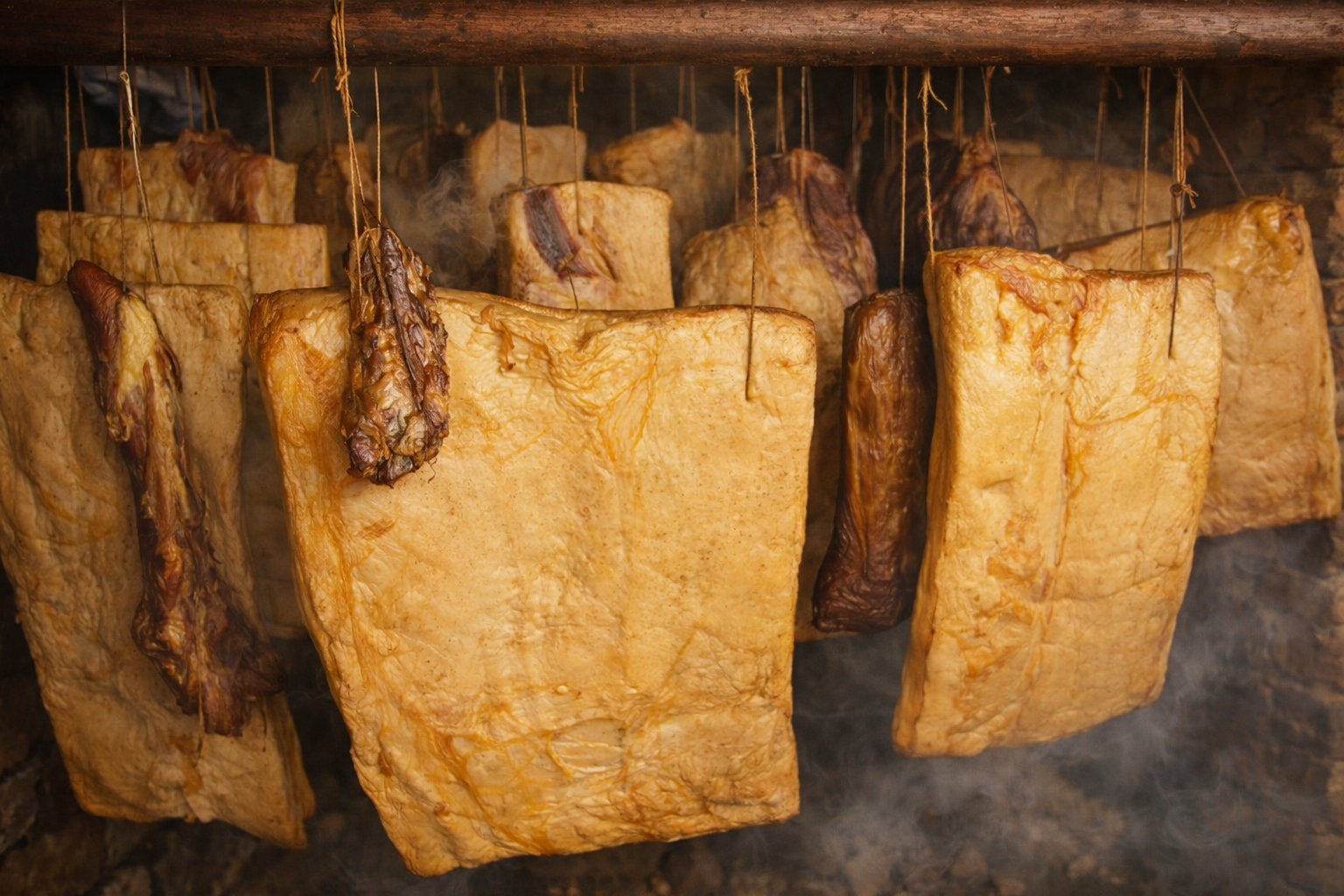
The answer is simple: almost anything connected with meat and homemade processing. In traditional Hungarian cuisine, smoking was used mainly for products made after pig slaughter. These included sausages, head cheese, salami, liver sausage, ham, bacon, and smoked ribs.
Smoking, however, was not limited to pork. Fish could also be smoked, along with other less obvious foods. Smoked cheese is familiar to many people today, but culinary traditions show that smoke was also used for more unusual specialties. This variety is one of the reasons smoking remains so valued—not only as a method of preservation, but also as a versatile culinary technique.
Still, in Hungarian tradition, homemade meat products always held a special place. They formed the foundation of the winter pantry, and the most characteristic smoking methods were developed around them.
Climate and Traditional Smoking Methods
Climate has always influenced how smoking was done. Conditions in humid areas were different from those in cooler regions, and both differed from the dry air of the plains. These factors affected how quickly meat dried, how long it needed to be smoked, and what the final flavor would be like.
In Hungary, local natural conditions and knowledge passed down from generation to generation meant that different regions could develop their own customs for preparing hams, bacon, and sausages. That is why it is fair to say that every household had its own way of producing perfectly smoked meat. Tradition was never entirely uniform—it was built on shared principles, but shaped by local conditions and family preferences.
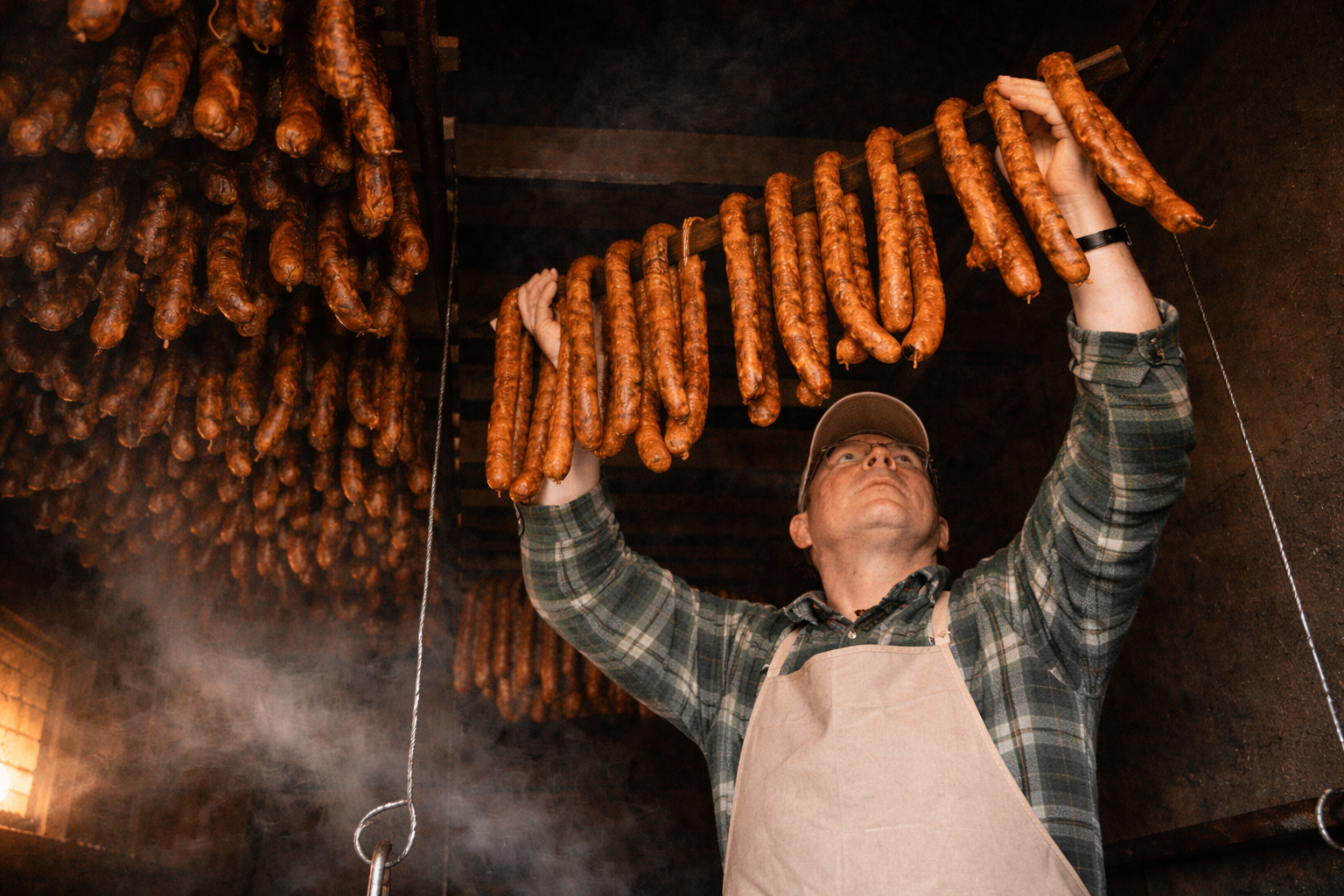
Types of Smoking Traditionally Used in Hungary
Traditional smoking generally includes three main methods: cold smoking, warm smoking, and hot smoking. Each method has its own purpose, requires a different temperature, and produces a different result. Choosing the right method determined the product’s shelf life, texture, and flavor.
Cold Smoking
Cold smoking takes place at temperatures between 54°F and 75°F (12°C to 24°C). It is one of the most classic methods of preserving meat, especially for traditional hams and other long-lasting products.
The most important requirement is that the product must be properly dried beforehand. Ham, sausage, or other meats had to enter the smoking chamber already partially dried. This helped the process proceed evenly and reduced the risk of spoilage during the long exposure to smoke.
This was the method most often used for preserving hams. Cold smoking takes a long time—usually several days, and in some cases up to six weeks. The result is a durable product with a deep flavor, well suited for long-term storage. In traditional Hungarian food culture, this was one of the most important techniques for preserving meat for later use.
Warm Smoking
Warm smoking is done at temperatures between 86°F and 122°F (30°C to 50°C). Depending on the type of meat or product, the process can last anywhere from 2 to 24 hours.
This method was mainly used for foods intended to be eaten sooner. Unlike cold smoking, it was not meant for preserving meat for many months, but rather for producing items that would stay good for a shorter period—usually up to two or three weeks.
Warm smoking gives food a noticeable smoky aroma while allowing the meat to remain juicier and more tender. It is a balance between shelf life and delicacy. For that reason, it was highly valued in traditional households whenever the products were meant to be consumed relatively quickly.
Hot Smoking
Hot smoking uses even higher temperatures, ranging from 122°F to 194°F (50°C to 90°C). It is the fastest of the traditional methods, with the process usually lasting from 30 minutes to a maximum of 2 hours.
The shorter processing time also means a shorter shelf life. The advantage of this method is that it helps preserve the tenderness of the meat or fish. That is why hot smoking is especially well suited to fish, poultry, and rabbit.
Although this technique delivers a quick result and a strong smoky flavor, it was not intended for the same kind of long-term preservation as cold smoking. Even so, it remains an important part of traditional food preparation, including in the context of Hungarian home cooking.
What Wood Should Be Used for Smoking?
In traditional smoking, the choice of wood is extremely important. According to long-established food-smoking practices, natural smoke from freshly cut hardwood is used. The most common types are oak, beech, alder, and birch, along with wood chips made from these trees.
These woods produce clean smoke and help create the desired flavor and color in the final product. The type of wood affects not only the aroma, but also the course of the smoking process itself.
Softwood, especially coniferous wood, is generally avoided because it can produce heavy soot deposits. That effect is not always desirable, although taste preferences can vary by region. In some places, darker, more heavily smoked meat is considered especially attractive. In traditional smoking, however, the most important things are the quality of the smoke and careful control of the process.
Is Smoked Meat Healthy?
This question comes up often. Over the years, many misconceptions have grown around smoked foods. One of the most common is the belief that smoked meat is inherently unhealthy. In reality, the key issue is not smoking itself, but how it is done.
If the temperature is too high or unsuitable smoking materials are used, substances may indeed form that can be harmful. That is why proper technique matters. As a practical rule, the burning or smoldering temperature should not exceed 932°F (500°C).
In practice, this means traditional smoking requires knowledge, experience, and patience. Proper smoking is not a matter of exposing meat to random smoke. It is a controlled process involving temperature, airflow, and the right type of wood. That is exactly why old methods, refined over generations, were based on care and precision.
A Flavor of Tradition That Is Hard to Resist
The greatest strength of smoking is that it gives food a unique flavor, aroma, and color. Thanks to this process, an ordinary cut of meat becomes a distinctive delicacy with depth and character. It is hard to resist a well-smoked ham, an aromatic sausage, or a hearty dish made with smoked meats.
In traditional Hungarian cuisine, smoking was more than just a preservation method. It was part of everyday life, a family ritual, and an important piece of culinary heritage. That is why it still captures the imagination today—both among lovers of homemade foods and among those interested in traditional methods of preparing meat.
It is also worth remembering that curing was an essential step in preparing meat for smoking. Without it, there is no true traditional smoking process. But that is a topic for another article of its own.


![616x948_Eros_Pista_2600g_616x948px_202210_gasztro[1].png](/environment/cache/images/productGfx_570_500_500/616x948_Eros_Pista_2600g_616x948px_202210_gasztro1.webp "616x948_Eros_Pista_2600g_616x948px_202210_gasztro[1].png")


